Hems

Custom Search
Showing posts with label Some popular Telescopes. Show all posts

Sunday, 10 April 2011

A Binoculars [Explaination]

Optical instrument for providing a magnified view of distant objects, consisting of two similar telescopes, one for each eye, mounted on a single frame.

In most binoculars, each telescope has two prisms, which reinvert the inverted image provided by the eyepiece of each telescope. Light rays travel along a folded path inside the telescopes, so the instrument has a shorter overall length. The prisms also provide better depth perception at greater distances, by allowing the two objectives (object lenses) to be set farther apart than the eyepieces. Binocular eyepieces are often fitted to microscopes or other optical instruments.

Radio Telescopes


Radio telescopes vary widely, but all have two basic components: a large radio antenna or an antenna array and a radiometer or radio receiver. Because some astronomical radio sources are extremely weak, radio telescopes are usually very large, and only the most sensitive radio receivers are used. The first large fully steerable radio telescope was completed in 1957 at Jodrell Bank, Eng. The world's largest fully steerable radio telescope is the 360 × 330-ft (110 × 100-m) off-axis antenna operated by the National Radio Astronomy Observatory in Green Bank, W.Va. The largest single radio telescope is the 1,000-ft (305-m) fixed spherical reflector at the Arecibo Observatory in Puerto Rico. The world's most powerful radio telescope is the Very Large Array in New Mexico, made up of 27 separate mobile parabolic antennas that together provide the angular resolution of a single antenna 22 mi (35 km) in diameter.

Combination of radio receiver and antenna, used for observation in radio and radar astronomy

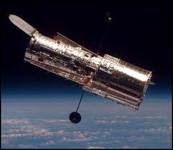
Hubble space telescope (HST)

                                          Hubble space telescope(HST)
Most sophisticated optical observatory ever placed into orbit around Earth.
Because it is above Earth's obscuring atmosphere, it can obtain images much brighter, clearer, and more detailed than ground-based telescopes can. Named for Edwin Hubble, it was built under NASA supervision and deployed on a 1990 space-shuttle mission. The reflector telescope's mirror optics gathers light from celestial objects and directs it to an array of cameras and spectrographs (see spectroscopy). A defect in the primary mirror initially caused it to
 produce fuzzy images; in 1993 another shuttle
mission corrected this and other problems. Subsequent missions to the HST have been for maintenance, repairs, and instrument upgrades.