Working principle
sand advantages

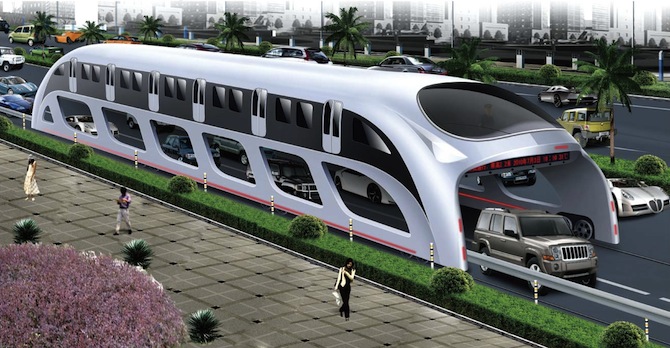
The straddling bus combines the advantages of BRT, it is
also a substitution for BRT and subway in the future. As you all know, the
majority vehicle on the road is car, the shortest vehicle is also car. Normally
our overpass is 4.5-5.5 m high. The highlight innovation of straddling bus is
that it runs above car and under overpass. Its biggest strength is saving road
spaces, efficient and high in capacity. It can reduce up to 25-30% traffic jams
on main routes. Running at an average 40 km/h, it can take 1200 people at a
time, which means 300 passengers per cart.
Another strength of straddling bus is its short construction
life cycle: only 1 year to build 40 km. Whereas building 40-km subway will take
3 years at best. Also the straddling bus will not need the large parking lot
that normal buses demand. It can park at its own stop without affecting the
passage of cars. This is what the interior looks like: it has huge skylight
that will eliminate passengers’ sense of depression when enter.
There are two parts in building the straddling bus. One is
remodeling the road, the other is building station platforms. Two ways to
remodel the road: we can go with laying rails on both sides of car lane, which
save 30% energy; or we can paint two white lines on both sides and use
auto-pilot technology in the bus, which will follow the lines and run stable.
There are also two ways in dealing with station platform.
One is to load/unload through the sides; the other is using the built-in ladder
so that passengers can go up and to the overpass through the ceiling door.
Straddling bus is completely powered by municipal
electricity and solar energy system. In terms of electricity, the setting is
called relay direct current electrification. The bus itself is electrical
conductor, two rails built on top to allow the charging post to run along with
the bus, the next charging post will be on the rails before the earlier one
leaves, that is why we call it relay charging. It is new invention, not
available yet in other places.
The set here is super capacitor, a device that can charge,
discharge and store electricity quickly. The power it stores during the stop
can support the bus till the next stop where another round of charging takes place,
achieving zero toxic gas throughout the process.
About the ultrasonic waves put forth from the end of the
bus, that is to keep those high cars or trucks away from entering the tunnel.
Using laser ray to scan, cars get too close to the passage will activate the
alarm on the bus end. Inside the bus, there are turning lights that indicate a
the bus is intending to make a turn to warn the cars inside. Also radar
scanning system is embedded on the walls to warn cars from getting too close to
the bus wheels.
Nowadays many big cities have remodeled their traffic
signaling system, to prioritize public buses, that is to say when a bus reaches
a crossing, red light on the other side of the fork will turn on automatically
to give buses the right of way. Our straddling bus can learn from this BRT
method. The car can make the turn with the bus if that is the direction it
wants to go too; if not, the red light will be on to stop the cars beneath
while the bus take the turn.
The bus is 6 m in width and 4-4.5 m high. How will people
get off the bus if an accident happens to such a huge bus? Here I introduce the
most advanced escaping system in the world. In the case of fire or other
emergencies, the escaping door will open automatically. I believe many of you
have been on a plane. Planes are equipped with inflated ladder so people can
slide down on it in emergency. I put the escaping concept into the straddling
bus. It is the fastest way to escape.
The bus can save up to 860 ton of fuel per year, reducing
2,640 ton of carbon emission. Presently we have passed the first stage
demonstration and will get through all of the technical invalidation by the end
of August. Beijing’s Mentougou District is carrying out a eco-community project,
it has already planned out 186 km for our straddling bus. Construction will
begin at year end.
That’s whay china is in still top position.

 1. Asteroids are remains of a rocky planet
to form between Mars and Jupiter 4.5 billion years ago.
1. Asteroids are remains of a rocky planet
to form between Mars and Jupiter 4.5 billion years ago. 3. These rocky and metallic objects were
scattered through out the solar system crashing into the planets.
3. These rocky and metallic objects were
scattered through out the solar system crashing into the planets.